
Systems · 4 min read
What Is Prompt Engineering? A Beginner's Guide to Better AI Results
Learn what prompt engineering means, why it matters now, and a four-part framework you can use today to get better answers from ChatGPT, Claude, and Gemini.
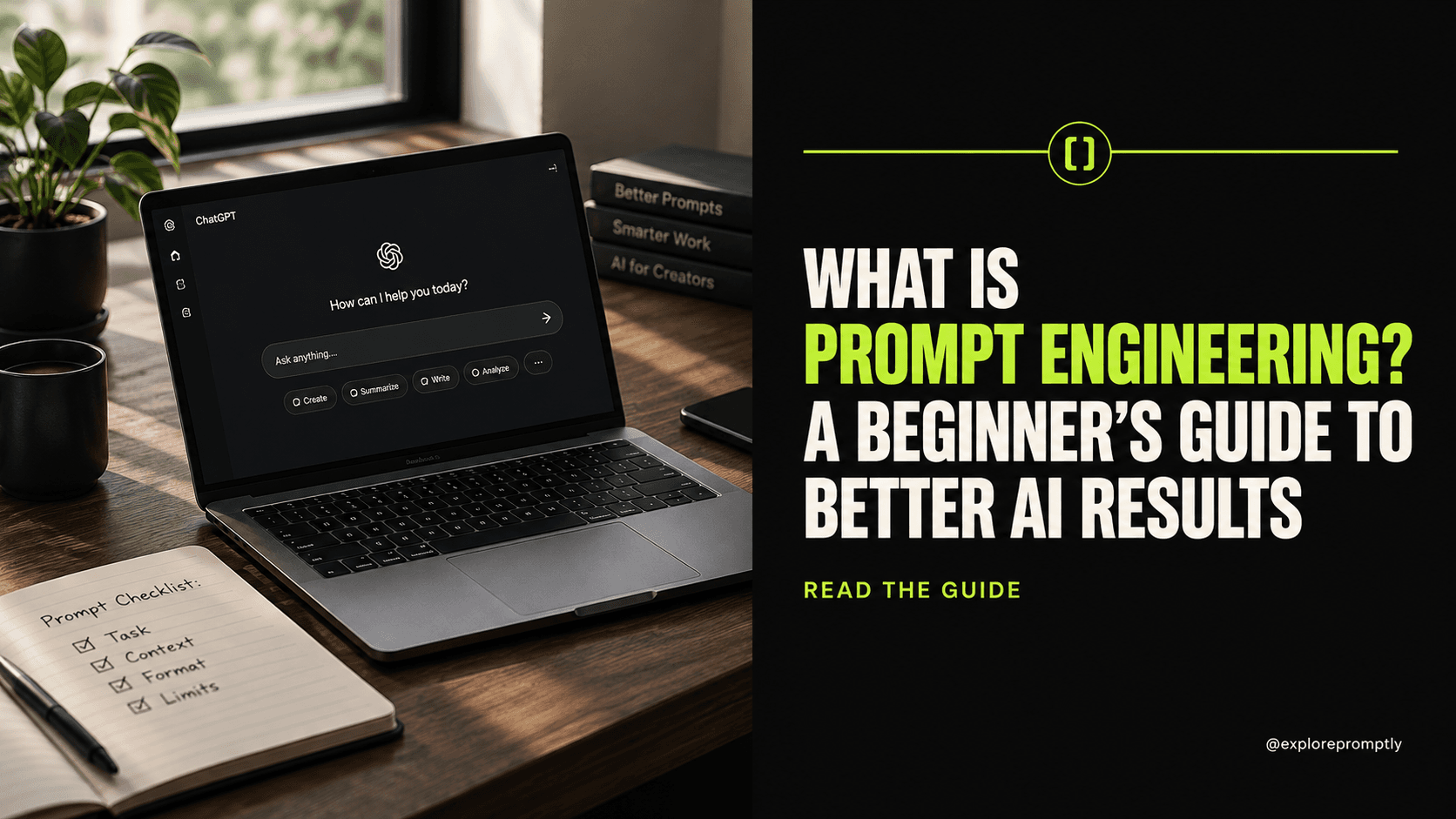
You type a question into ChatGPT. The answer sounds average. Someone else types almost the same question and gets something sharper, more specific, more useful. The gap between those two results has nothing to do with which AI model they used. It comes down to the prompt.
That gap is what prompt engineering closes.
What Prompt Engineering Means
Prompt engineering is the practice of writing instructions for an AI model in a way that gets you the output you want, the first time or close to it.
Here's why it works. A language model reads your text and predicts the next likely words based on everything you gave it. Give it a vague instruction and it fills the gaps with guesses. Give it a clear one, and it has far less room to guess wrong.
This isn't about secret phrases or clever wording tricks. It comes down to four things: what you want, who it's for, what shape the output should take, and what to leave out.
Why This Skill Matters Right Now
A few job boards briefly listed "prompt engineer" as a stand-alone title back in 2023 and 2024. By 2026, that title shows up less on its own and more as one line inside marketing, writing, support, and design job descriptions.
The skill didn't disappear. It moved from a specialty into a baseline expectation, similar to how spreadsheet skills became standard for office work in the 1990s. You don't need a certificate or a course. You need repetition and a working method.
If you write for a brand, run a small business, freelance, or manage social accounts, your AI output is only as sharp as your instructions. Improving prompt writing is one of the highest-return skills you're able to build this year, and it costs nothing but time.
A Simple Framework: Task, Context, Format, Limits
Most strong prompts include four ingredients. Miss two or three of them and the output tends to come back generic.
Task State the action first, with a verb. Write, summarize, compare, rewrite, outline, translate. Don't bury the instruction inside a paragraph of background.
Context Give the model the background information a human helper would need: who the audience is, what already exists, what the goal is.
Format Tell the model what shape you want back: a table, five bullet points, three paragraphs, a headline plus subhead, a specific word count.
Limits State what to avoid: tone, length ceiling, banned phrases, things the reader already knows and doesn't need repeated.
Put those four together and you get a prompt closer to a brief than a question.
A Bad Prompt vs. A Better Prompt
Example prompt (bad):
Write me a post about productivity.
This gives the model almost nothing to work with. No audience, no format, no tone, no limit. You'll get a generic, forgettable answer because the model has no target to aim at.
Example prompt (better):
Write a 150-word LinkedIn post for freelance designers about the cost of switching tasks too often during the day. Open with a specific, relatable moment instead of a general statement. Use short sentences and plain language. End with one small, concrete habit the reader can try today. Avoid corporate language and motivational clichés.
Why this version works better: it names the audience (freelance designers), sets a length, defines the opening style, states the tone, and tells the model what to cut. Every added detail narrows the range of possible answers down to the one you actually want.
Common Mistakes People Make With AI Prompts
-
Asking without context."Fix this email" gives the model nothing about tone, recipient, or goal.
-
Assuming memory across chats.A new conversation starts blank. Repeat the background it needs.
-
Stacking too many tasks in one instruction Asking for a strategy, three drafts, and a summary in one prompt usually produces a rushed version of all three. Break big requests into steps.
-
Skipping format instructions. Without a format request, most models default to a wall of paragraphs. Ask for the structure you need.
-
Accepting the first answer.The first response is a draft, not a final version. Tell the model what's wrong and ask for a specific fix.
-
Leaving out an example. When tone or style matters, one short example of the voice you want does more work than a paragraph describing it.
A Prompt Checklist You Can Reuse
Before you send a prompt, check it against this list:
- Does it name the task with a clear action verb?
- Does it state who the output is for?
- Does it specify format and length?
- Does it define tone or voice?
- Does it name anything to avoid?
- Would a new hire, with zero context on your project, understand what you're asking for?
If the answer to that last one is no, the model won't understand it either.
Prompt Engineering Is a Skill, Not a Job Title
Treat this as applied communication, not a mystical technical skill. The models will keep changing. The underlying habit, being specific about task, audience, format, and limits, holds up regardless of which model you're using this year or next.
It also won't guarantee a career path by itself. What it does is make every other skill you already have, writing, marketing, research, design, faster and more consistent when AI is part of the process.
What to Do Next
Pick one task you already ask AI to help with regularly: a caption, an email reply, a summary. Rewrite your usual prompt using the four-part structure above: task, context, format, limits. Run both versions and compare the results side by side.
That single comparison teaches the skill faster than reading about it does.
FAQ
- Is prompt engineering still a real job in 2026?
- Less as a stand-alone title, more as a skill folded into marketing, writing, and support roles. Expect to see it inside job descriptions rather than as the job itself.
- Do I need to learn a specific framework to write good prompts?
- No single framework is required. What matters is covering four things every time: the task, the context, the format you want back, and what to leave out.
- Does prompt engineering work the same way across ChatGPT, Claude, and Gemini?
- The core approach transfers. Wording sensitivity and formatting quirks differ slightly between models, but a clear, specific prompt outperforms a vague one on every model.
- Can one good prompt replace editing the output?
- No. Treat the first response as a draft. Point out what's wrong and ask for a specific fix rather than starting over.